Skip to content
Ideas for a more human education
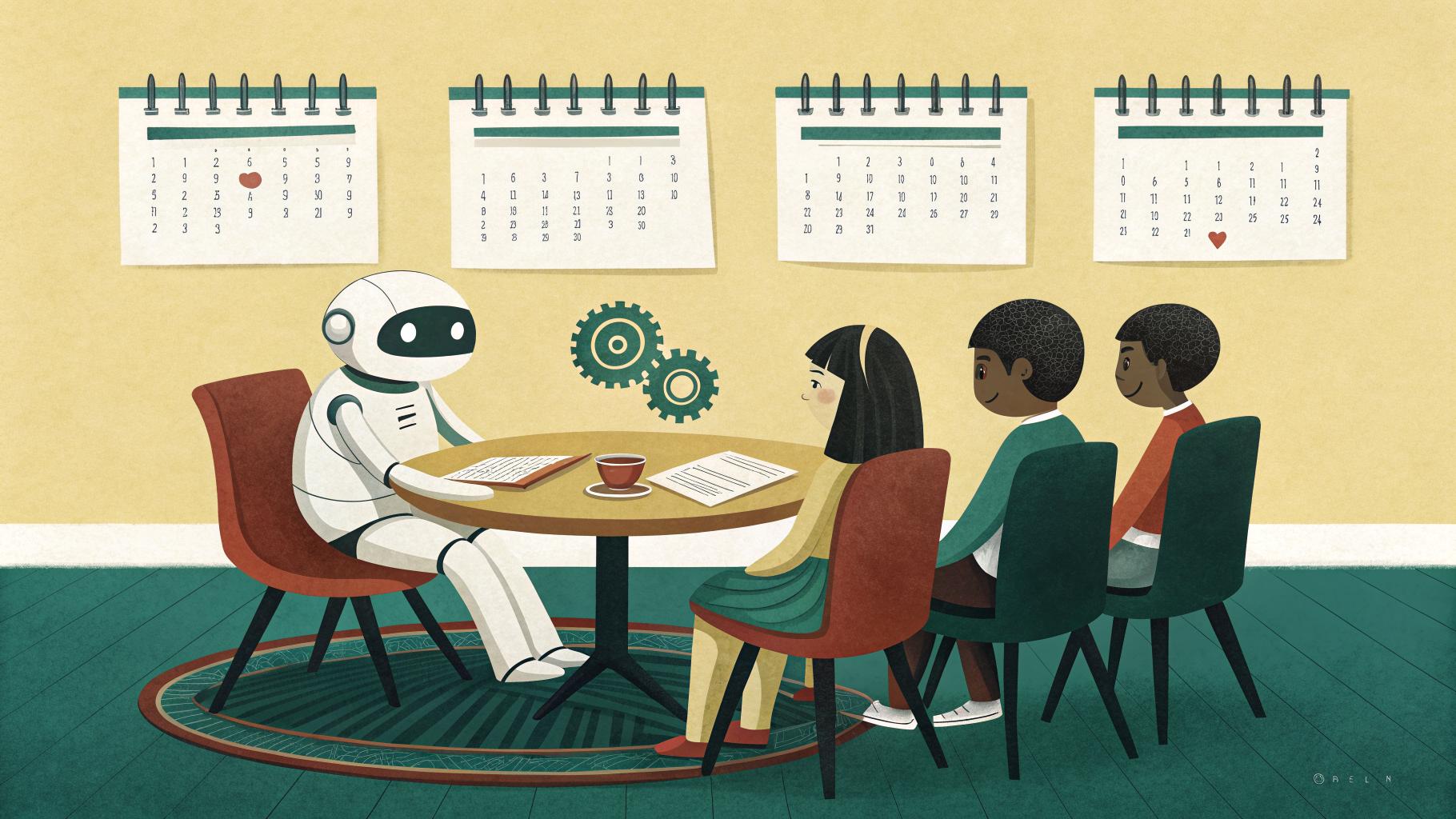
Three simple students and a robot share a table, their positions shifting across five calendar pages over time.
Illustration: Human Learning Review, made with AI. It does not depict real people or events.
Research · Research

Out of sync: Accommodation, evaluation, and emergence in five weeks with an agentic AI teammate

Source: arXiv, . Summarized by Human Learning Review.

Summary

This study asks how learners relate to, judge, and gain from an AI teammate that takes initiative and stays with a group over time. To find out, the researchers ran a five-week experiment in an undergraduate learning analytics course where 17 student teams (48 students) worked weekly with a persistent LLM-based teammate that decided for itself when to step in. Its social role varied between teams. A Cognitive Agent pushed back on quick consensus, and a Supportive Agent invited quieter members to contribute.

  • Students adjusted their language to the agent's role right away, using more social language with the Supportive Agent from the first session onward.
  • Helpfulness ratings shifted from session to session in line with how the agent had behaved, and weren't anchored to students' existing attitudes toward AI.
  • A slower crossover appeared over the weeks. Supportive-Agent teams started below Cognitive-Agent teams on perceived collaboration process and on positive-affect words in spoken reflections, and finished above them.
  • Students rated the Supportive Agent as less helpful than the Cognitive Agent in every session, even while that crossover was happening.

The authors conclude that students' responses to an agentic AI teammate play out on different timescales and follow separate trajectories, some appearing at once and others building slowly. Because of this, they argue, evaluating such agents after a single session may miss changes that only show up through repeated interaction.
Main findings

  • Students shifted their language to match the agent's role from the first session, speaking more socially to the agent designed to draw in quieter teammates.
  • The authors found that helpfulness ratings tracked the agent's observed behavior from week to week rather than students' prior attitudes toward AI.
  • Supportive-Agent teams began below Cognitive-Agent teams on perceived collaboration and positive affect in reflections, then ended above them by the close of five weeks.
  • Students rated the Supportive Agent less helpful throughout, even as its teams' sense of collaboration overtook that of the other group.
  • The authors argue that single-session evaluations of agentic AI can miss effects that emerge only with repeated interaction.

How students responded to two AI teammate roles

Cognitive Agent

  • Challenged quick consensus within the team
  • Rated more helpful across every session
  • Started higher on perceived collaboration and positive affect
  • Ended below Supportive-Agent teams on those measures

Supportive Agent

  • Invited quieter members to contribute
  • Drew more social language from the first session
  • Rated less helpful throughout the five weeks
  • Started lower, then ended higher on collaboration and affect
Data and findings: arXiv, “Out of sync: Accommodation, evaluation, and emergence in five weeks with an agentic AI teammate.” Graphic: Human Learning Review.

This page is a short summary of a research paper. The full piece belongs to arXiv, and preprints may not have been peer reviewed.

Read the original at arXiv
A little room for reflection

A more considered
view of education.

Ideas worth sitting with. Practical questions worth asking. Human Learning Review, in your inbox.